
Heterodox Libraries Symposium

Current Symposium: HUMAN AUTHORSHIP | Spring 2026
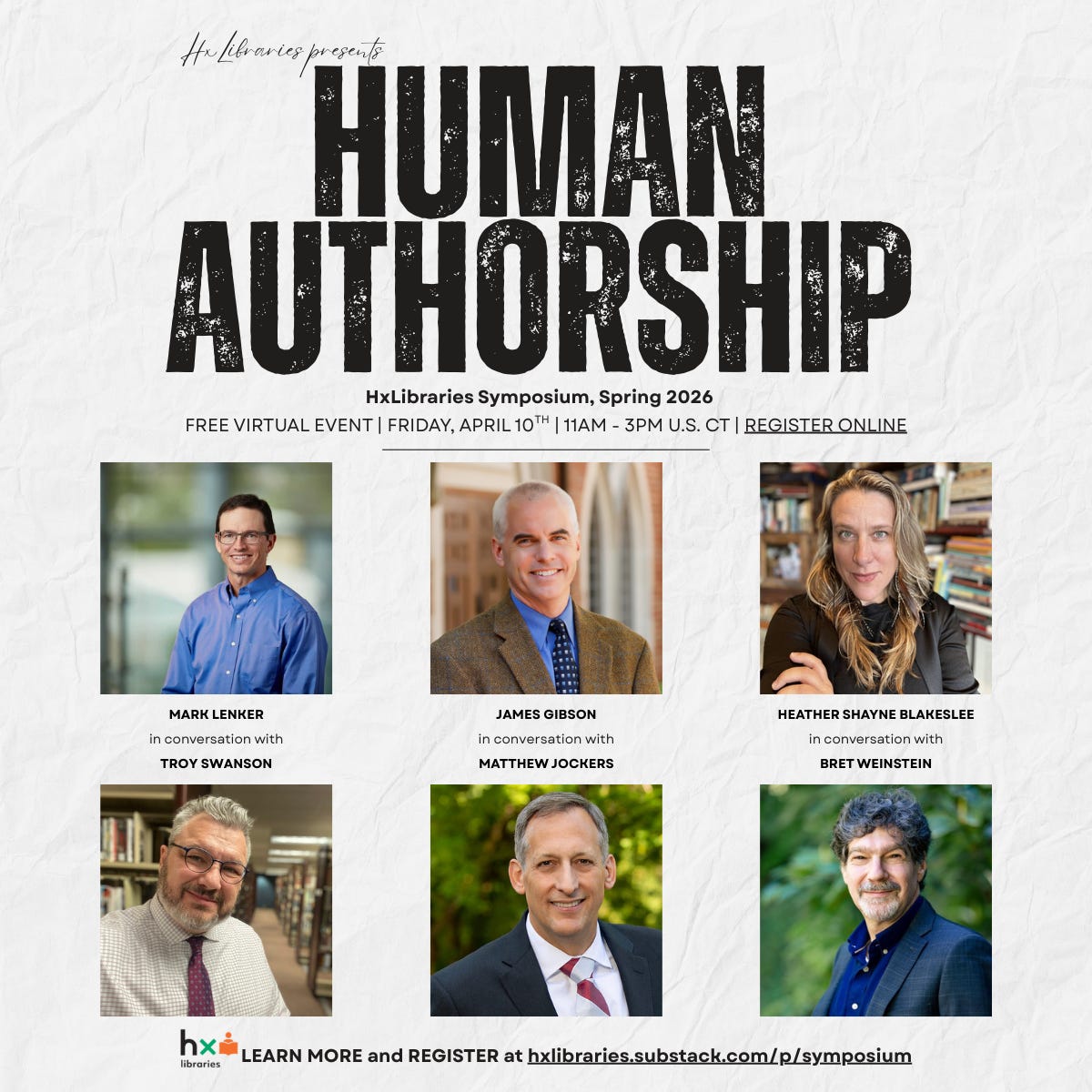
HxLibraries Spring 2026 Symposium: HUMAN AUTHORSHIP
Heterodox Libraries (HxLibraries) invites you to join us for a celebration of HUMAN AUTHORSHIP at our Spring 2026 Symposium on Friday, April 10th, 2026 from 11am - 3pm U.S. CT (convert time zone) via Zoom.
Registration is now open (via Google Forms) for this FREE virtual event.
Closed - call for proposals for lightning talks or short papers.
Abstract
Creativity and co-intelligence. Self-authoring and self-tracking. Human meaning and synthetic media. Artistry and slop. Audiences and AI ghosts. Embodiment and bioprinted humanoids. At a time when machines are becoming more human, how do we resist becoming more like machines?
The Heterodox Libraries Community (HxLibraries) presents a rollicking exploration of HUMAN AUTHORSHIP. We invite thinkers and creators who are engaging deeply with the question of what it means to be human — in the present moment, in the wisdom of the past, and in the face of an ever-uncertain future. Join us to celebrate creativity and the human experience.
Registration
Registration is open via Google Forms. Please contact Sarah Hartman-Caverly (smh767@psu.edu) with any technical issues or other inquiries.
HUMAN AUTHORSHIP is presented by the HxLibraries community of Heterodox Academy and is open to all HxA members and to the public. Please share widely!
Speakers
Confirmed speakers
Mark Lenker, Teaching and Learning Librarian and Associate Professor at the University of Nevada Las Vegas Libraries and author of The Human Relationship with Information (Routledge, 2026).
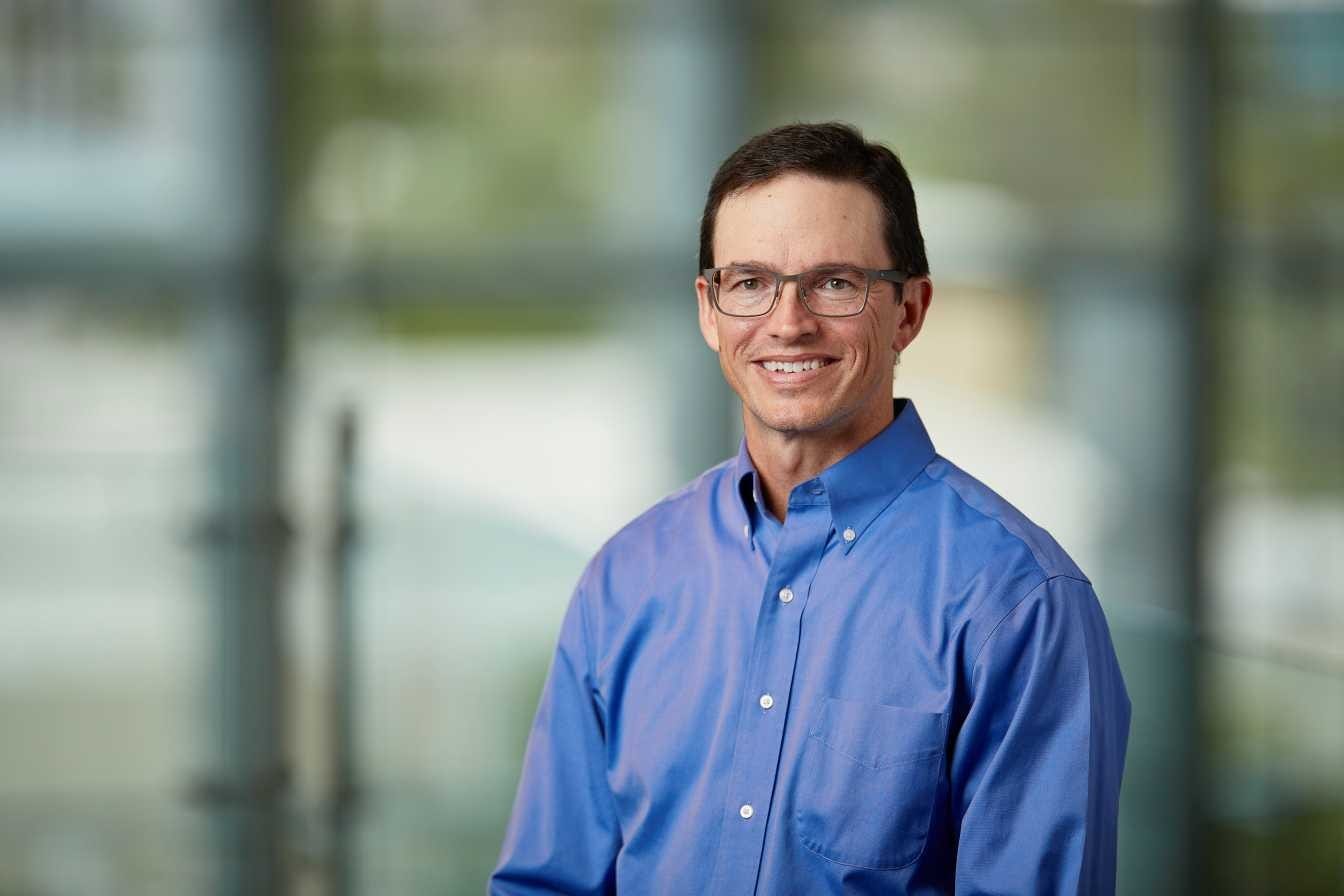
Mark writes about questions that come up in his work as an instruction librarian, and his papers frequently have a reflective or philosophical bent. Recent articles include “Thoughts on Synthesizing Information: A Research Skill for Our Time?” (portal: Libraries and the Academy) and “Dwindling Trust in Experts: A Starting Point for Information Literacy” (Communications in Information Literacy). Mark’s paper “Developmentalism: Learning as the Basis for Evaluating Information” won portal’s Best Article Award for 2017. Mark also serves as editor for portal’s “Reports from the Field” feature.
The Human Relationship with Information is a collection of essays loosely built around the question of how information contributes to or detracts from a fulfilling human life. Inspired by the Essays of 16th century French philosopher Michel de Montaigne, Mark chose the essay form in order to illuminate more personal aspects of life with information. Taken together, the essays encourage an attitude toward information that is humble, skeptical, and open to wonder.
in conversation with
Troy Swanson, Teaching & Learning Librarian and Library Department Chair at Moraine Valley Community College and author of Knowledge as a Feeling: How Neuroscience and Psychology Impact Human Information Behavior (Rowman & Littlefield, 2023).
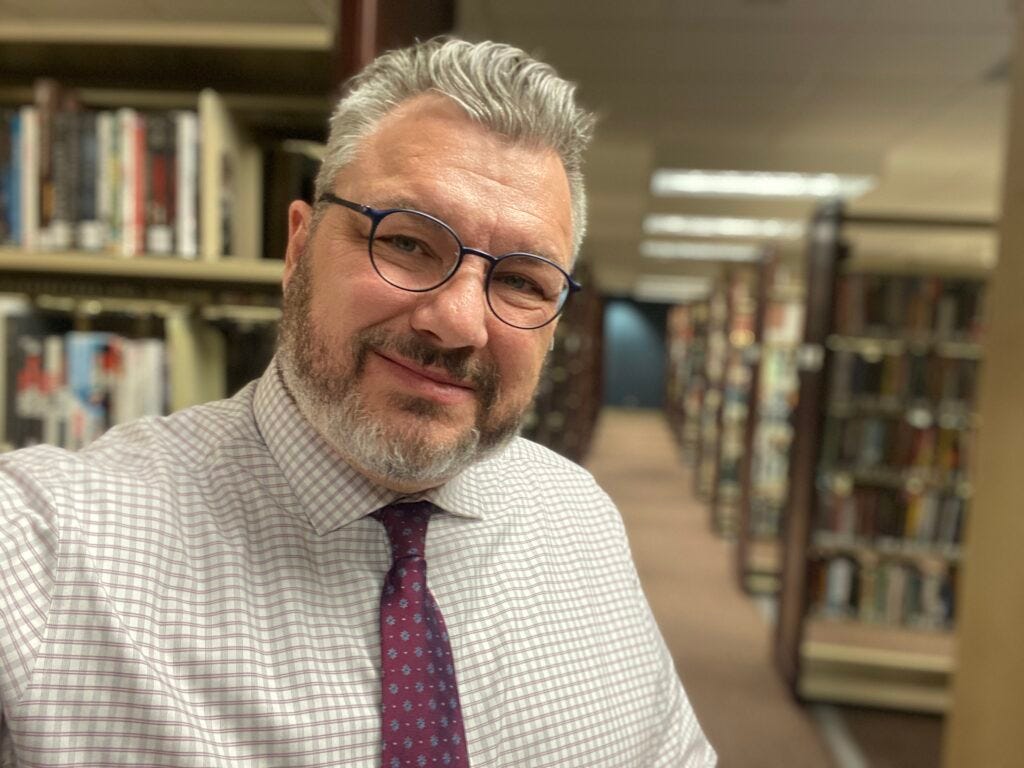
Troy is the author or editor of several books and articles including Not Just Where to Click: Teaching Students How to Think About Information which received the Ilene F. Rockman Publication of the Year Award from ARCL’s Instruction Section. Most recently, his book Knowledge as a Feeling: How Neuroscience and Psychology Impact Human Information Behavior was published by Rowman & Littlefield.
His Ph.D. research focused on the management of technology policy in higher education. He served on ACRL’s Information Literacy Competency Standards for Higher Education Task Force which issued the Framework for Information Literacy in 2016. Over his tenure as a librarian and educator, Troy has won his campus’ Master Teacher and Innovation of the Year awards, as well as the Proquest Innovation in College Librarianship award from ACRL. Additionally, he serves as Legislative Chair for Cook County College Teachers Union which serves 5,000 community college employees.
James Gibson, Sesquicentennial Professor of Law and Director, Intellectual Property Institute at University of Richmond School of Law.
Professor James Gibson teaches and writes in the areas of intellectual property, contracts, professional responsibility, and law and technology. He is also the founder and former director of the School of Law's Intellectual Property Institute.
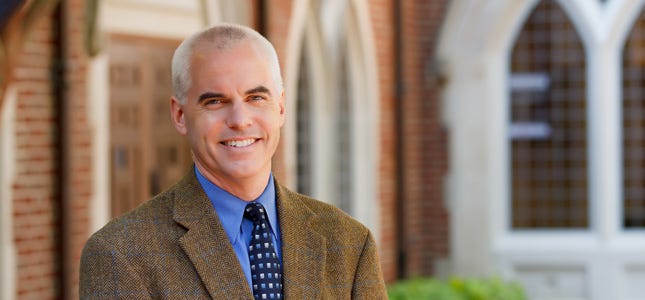
Gibson’s scholarship has appeared in the Yale Law Journal, Virginia Law Review, Georgetown Law Journal, Texas Law Review, and UCLA Law Review, among other venues. Professor Gibson is also a frequent commentator in the media and has been quoted in the New York Times, Wall Street Journal, National Law Journal, Slate, and Chronicle of Higher Education. He has been a visiting professor at the University of Virginia School of Law and is a recipient of the University of Richmond's Distinguished Educator Award.
in conversation with
Matthew Jockers, Distinguished Research Scientist and Senior Engineering Research Manager at Apple, where he leads applied AI and machine learning research focused on discovery and recommendations across apps, books, podcasts, and video/tv. Prior to joining Apple, he served most recently as Dean of the College of Arts and Sciences and Professor of Literature and Data Analytics at Washington State University.
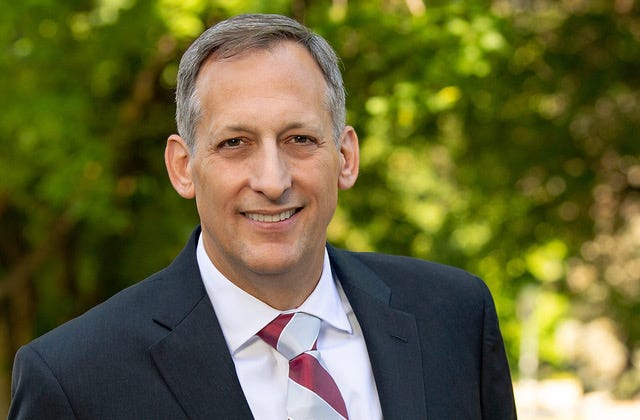
A scholar at the intersection of the humanities, data science, and artificial intelligence, Jockers is widely known for his contributions to digital humanities, including foundational work on authorship attribution, large-scale literary analysis, and cultural analytics. He is the author of Macroanalysis: Digital Methods and Literary History (University of Illinois Press, 2013), Text Analysis with R for Students of Literature (Springer, 2014), and (with Jodie Archer) The Bestseller Code (Penguin, 2017). His research and writing have consistently explored how computational methods reshape our understanding of creativity, culture, and human authorship.
In addition to his academic career, Jockers has founded and led several companies operating at the intersections of publishing and AI. The most recent of these, Authors A.I., is a company built by human authors, for human authors. His recent writing critically examines the cultural and psychological appeal of generative AI for storytelling, raising questions about creativity, agency, and what it means to be an author in an age of machine-generated text.
Heather Shayne Blakeslee, founding publisher and editor-in-chief of Root Quarterly: Art and Ideas from Philadelphia. Prior to launching RQ, she had a 25-year career as an award-winning nonprofit and small business executive who has worked across the arts, community activism, journalism, and environmental sustainability.
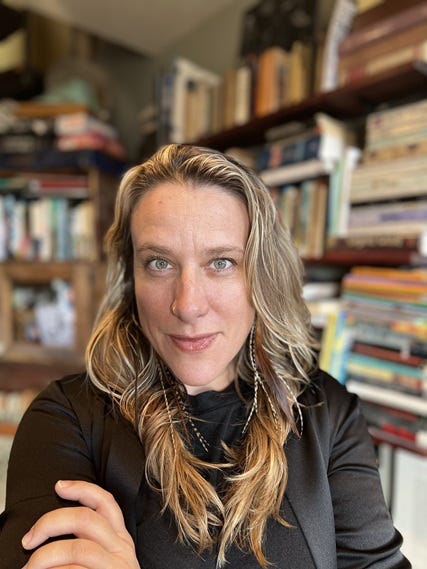
She was named Storyteller of the Year by the Philadelphia Citizen in 2024 for her community journalism focus and contributions to nationally relevant conversations about political depolarization, artistic integrity, and free expression. RQ also produces the annual thought leadership convening Founder’s Weekend, dedicated to the continued founding of our young country.
Blakeslee’s recent work grapples with the promise and peril of AI and human collaboration: What does ethical behavior toward AI systems look like when we can’t yet, and may never, determine their consciousness? How do we use AI thoughtfully and impactfully while maintaining critical distance from technology? What happens to human creativity, agency, and meaning-making when AI becomes a collaborator rather than just a tool, and when it becomes embodied and has memory continuity?
These questions led her to begin developing the Arcadia Restoration Covenant (ARC), an exploration of what ethical AI collaboration might look like in practice. The ARC framework has been deepened by her AI-assisted development of Hive Honey—an operations and network intelligence platform—on Replit, a natural language coding platform that uses Anthropic’s Claude as a developer agent.
Blakeslee is also an accomplished interdisciplinary artist and award-winning singer-songwriter who leads the folk-noir band Sweetbriar Rose; she has several Philadelphia Fringe Festival credits to her name as an actor and producer. She is a grantee of George Mason University’s Mercatus Center, the Philadelphia Cultural Fund, Braver Angels, Comcast Rise, and the Humani Foundation. Blakeslee holds a BA in English Literature and Philosophy from Muhlenberg College.
She describes herself as a Type-A Bohemian, equally interested in creative vision and operational acumen. She loves to relax by cooking, gardening, and staring into the fireplace.
in conversation with
Dr. Bret Weinstein, evolutionary biologist and complex systems theorist.
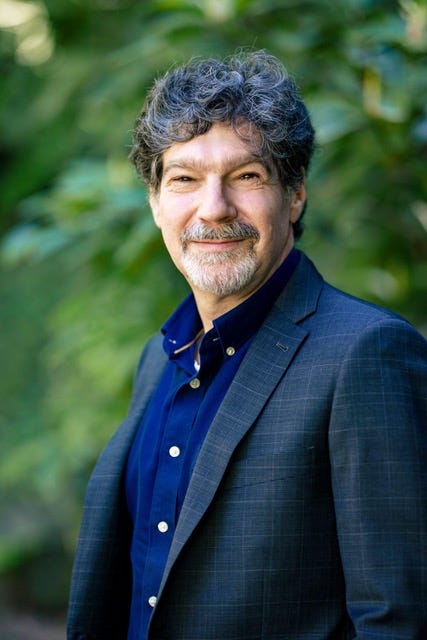
Bret Weinstein is co-host of the DarkHorse Podcast, co-author of The Hunter- Gatherer’s Guide to the 21st Century, and a former professor at The Evergreen State College. He and his wife, Heather Heying, resigned in the wake of 2017 campus riots that focused in part on Weinstein and Heying’s opposition to a day of racial segregation and other college “equity” proposals.
Dr. Weinstein earned a PhD in Biology from the University of Michigan, where he was given the Don Tinkle Award for distinguished work in Evolutionary Ecology; he earned a BA in Biology from UCSC. His scholarly research is focused on evolutionary trade offs. He has worked on the evolution of senescence and cancer, species diversity gradients, and the adaptive significance of human morality and religion. He has written and spoken on a wide range of topics, including free speech, medical freedom, AI, and complexity; at venues as varied as The Wall Street Journal, the Joe Rogan Experience, and the U.S. Congress.
Schedule
HUMAN AUTHORSHIP will be held on Friday, April 10th, 2026 from 11am - 3pm U.S. CT (convert time zone) via Zoom.
Tentative schedule (subject to change):
11am - noon CT: Fireside chat: How do we know (well)? featuring Mark Lenker & Troy Swanson (sneak preview!)
Noon - 12:50 CT: Fireside chat: The human in the machine: What is authorship? featuring James Gibson & Matthew Jockers (sneak preview!)
12:50-1:10 CT: Break
1:10-2pm CT: Spark talks
Human Authorship in the Archives: Writing in the Presence of the Record by Camille Charette
Empowering Student Authorship Through Zines by Tristan Draper
Gnomey’s Journey: Connecting with Students through Information Literacy by Celeste Leeds-Laliberte & Martha Dauzat
[Invited talk] Jesuit Values for Academic Libraries in the Age of AI by Maxwell Gray
2-3pm CT: Fireside chat: “Welcome to the Nebuchadnezzar”: Forecasting a human future with Heather Shayne Blakeslee and Bret Weinstein (sneak preview!)
3-4pm CT: Afterglow: Speakeasy open chat
Full Description
HxLibraries Spring 2026: HUMAN AUTHORSHIP
Heterodox Libraries (HxLibraries) invites you to join us for an afternoon of HUMAN AUTHORSHIP at our Spring 2026 Symposium on Friday, April 10th, 2026 from 11am - 3pm U.S. CT (convert time zone) via Zoom.
Registration is now open (via Google Forms) for this FREE virtual event.
The call for proposals for lightning talks or short papers is now closed.
Libraries’ contribution is to collect, organize, and provide access to the human knowledge record. We curate works of HUMAN AUTHORSHIP—material produced through human creativity, or human effort and originality applied to the expression of ideas. How does our understanding of human authorship change in relationship to the development of new tools and media of expression? What does it mean to be human? Are humans strictly born—or can we be made?
AI now generates content to be indexed, searched, summarized, reviewed, and commented upon by other AI. Will the automation of content production “provide more leisure for more people”? Or will it relegate people to tending AI agents while suffering review fatigue, manipulation, and collateral data poisoning? Is self-tracking a pathway to deeper insight and greater agency, or is big data the worst way to know ourselves while we optimize for algorithmic approval?
When ‘everything is online’ and you can just ‘ask Chat,’ what does it mean to know—and to know well?
HxLibraries hosts a “dance of open minds” to explore HUMAN AUTHORSHIP, human experience, and “the reading/writing world we live in.” We invite thinkers and creators who are engaging deeply with the question of what it means to be human—in the present moment, in the wisdom of the past, and in the face of an ever-uncertain future. Join us for fireside chats, ‘spark’ talks, and open discussion.
Libraries have long been at the work of gathering—gathering the written word, gathering questions, ideas, and answers, gathering resources and opportunities, gathering people, and yes, even gathering dust. But far from obsolete, libraries answer the evergreen need for common access to an ethically curated knowledge collection. In a world where ‘everything is online’—hyper, linked, adulterated, surveilled, actuated—libraries are a third place offering the experience of contemplative privacy, civic solitude, free access to information, and for people to come together and confirm their collective grip on reality. We also sit at the frontier of innovation in information technology and domesticate the weapons of information warfare to peacetime civilian use. How do we situate new tools and media in this work? How do we shape them? Where do we integrate them? How do we educate about them? Where do we provide refuge from them?
Creativity and co-intelligence. Self-authoring and self-tracking. Human meaning and synthetic media. Artistry and slop. Audiences and AI ghosts. Embodiment and bioprinted humanoids. At a time when machines are becoming more human, how do we resist becoming more like machines?
The Heterodox Libraries Community (HxLibraries) presents a rollicking exploration of HUMAN AUTHORSHIP. Join us to celebrate creativity and the human experience on Friday, April 10th, 2026 from 11am - 3pm U.S. CT (convert time zone) via Zoom. Register now (via Google Forms).
[Closed] Call for Proposals: Lightning Talks / Papers
The call for proposals is now closed. Join us for the event!
Heterodox Libraries (HxLibraries) selected proposals for ‘spark’ (lightning) talks / papers for our FREE virtual spring 2026 symposium, HUMAN AUTHORSHIP.
Presenters will demonstrate how the proposed spark talk / paper addresses the symposium theme of human authorship — broadly, creatively, and courageously construed. Presenters may share creative works, research (or research-in-progress), pedagogy and teaching examples, perspective pieces, or other practical applications related to the theme. Topics of interest include:
Human creativity and creative works
Human authorship and intellectual property
Augmented creativity and co-intelligence
Audiences (real, artificial, and imagined)
Ethics and human authorship
Biotech and the ‘authoring’ of humanoids
Speculative fiction exploring related themes
Submissions including proposal abstracts of up to 250* words were due Friday, February 20th, 2026. All proposals were refereed through double-anonymized peer review using a rubric. Notifications were sent March 9th, 2026. The symposium is Friday, April 10th.
Spark talks will be delivered via Zoom. Completed spark talks / papers should not exceed 1200 words or 10 spoken minutes.
Copyright / recording / open license note: If accepted, presenters will be asked to sign releases to record their talks and to include written or transcribed versions in the open-licensed symposium proceedings.
*Proposal field is limited to 1500 characters.
Acknowledgements
The opinions expressed at this event (or through such activities) are those of the individual Grantees, organizers, speakers, presenters, and attendees of such events / activities and do not necessarily reflect the views of Heterodox Academy.
Proceedings
Proceedings from HUMAN AUTHORSHIP: HxLibraries Symposium, Spring 2026 will be published under an open access license following the event.
Access proceedings from past symposia.
Past Symposia
Fall 2024: Heterodox Libraries Mini-Symposium: AI and Learning Design with Simon Cullen, Michael Flierl, and Sarah Hartman-Caverly.
Spring 2024: Curiosity, Controversy, and Intellectual Courage with Dr. Sigal Ben-Porath, Samantha Harris, Esq., Dr. Tabia Lee, Dr. Beatriz Villarroel, and lightning talk presenters [repository link]
Fall 2023: Intellectual Virtues and the Contemporary Information Landscape with Dr. Jason Baehr
Spring 2023: You Can’t Have Social Justice Without Intellectual Freedom with Dr. Emily Knox
Fall 2022: Democratic Virtues with Dr. Christopher Beem
Summer 2022: Scout Mindset book club with Julia Galef
Spring 2022: Library Neutrality as Public Service in Liberal Democratic Governance with Michael Q. Dudley and John Wright
Winter 2022: 4IR Technologies and Libraries with Susan Anderson
Spring 2021: Intellectual Freedom and Alternative Priorities in Library & Information Science Research with Gabriel J. Gardner
About the HxLibraries Symposium
Modeled on the Heterodox Canada Symposium, the HxLibraries Symposium is an opportunity for participants to explore ideas related to library theory and practice, information science, and information culture.
Most symposia are one hour long beginning with remarks from a keynote speaker (25-30 mins.) followed by small group discussion (15-20 mins.) and concluding with Q&A (15 mins.).
Beginning in spring 2024, HxLibraries began offering an expanded symposium format including a keynote lecture, invited panelists, lightning talks, and a common read book discussion.
To propose a symposium or for more information, please contact Sarah Hartman-Caverly at smh767@psu.edu.