
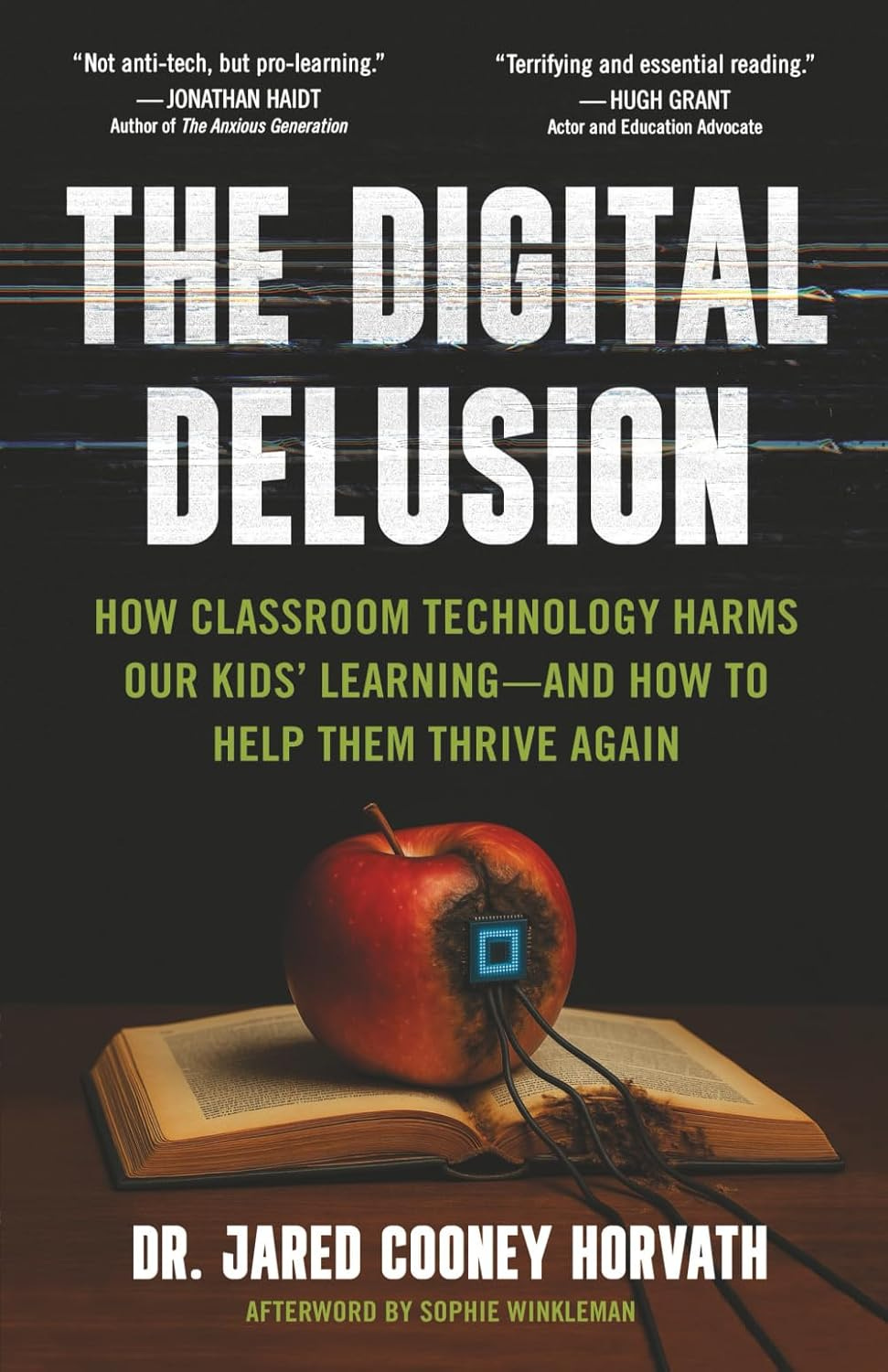
The Digital Delusion: How Classroom Technology Harms Our Kids’ Learning—and How to Help Them Thrive Again by Dr. Jared Cooney Horvath
A Review and Extended Reflections
In recent years we’ve seen inflated rhetoric about “moral panics” levelled against those who write about, and research, the reported harms caused by smartphones and a number of social media platforms. Yet, such rhetoric itself risks becoming overblown, when set against the sincere concerns of teachers, parents, policy makers, and ordinary citizens about the effects of phones and social media they are seeing on the attention, behavior, and mental health of adolescents and younger children—and the effects on learning and behavior in schools. The moral panic clamor has become formulaic and trope-filled, susceptible to groupthink, and is an example of what psychiatrist Robert Jay Lifton once called a “thought-terminating cliche.”
According to one group of experts, current concerns about smartphones and social media must be set in the same vein of previous “moral panics” such as those that parents (and teachers) incited about comic books, rock music, and video games. The obvious category error in equating the effects of comic books, rock music, and video games (as media), with portable Internet-enabled devices (as technologies), with facile links to social media platforms, somehow escapes these experts. The ubiquity of smartphones as delivery devices for social media “content” from the open Internet is their signature feature—allowing doomscrolling, distractibility, and forms of addiction that even recently disclosed internal reports from Meta acknowledge as problematic and harmful.
Among much else in the smartphone and mental health debate, shortform videos (TikTok, Instagram Reels, and YouTube shorts), as well as gaming and porn sites, might plausibly be considered corrupters of attention and mental health. To mention one example, a recent study shows the harmful effects of shortform videos, in particular, on the ability to attend, to focus, and to learn—all related to declining mental health.
But there are now larger, but related debates beyond smartphones about “Ed Tech” and its enormous influence in schools.
With his new book, The Digital Delusion: How Classroom Technology Harms Our Kids’ Learning—and How to Help Them Thrive Again, author Jared Cooney Horvath brings to this discussion a rare combination of knowledge and talent, having been both classroom teacher in public schools, but also holding an advanced degree in neuroscience.
With a title like this one, some might assume the author is inciting a “moral panic” or has written an anti-technology screed. Such is not the case. He has delved into the myriad aspects of what is now called “the science of learning” from the vantage point of how the brain works. He understands key developmental stages for children and teenagers, as well as college students, as they grapple with the perennial challenges of learning increasingly complex ideas, skills, and abilities.
His new book brings home, with an abundance of evidence, how our system of public education has been corrupted by fealty to bad ideas about the supposed benefits of “learning with technology”—specifically screen-based “learning” —by using devices ubiquitously at all levels of education in K-12 and also in higher education.
Horvath’s clarity about the stakes in learning—as opposed to the technology companies’ “engagement” metrics—is the outstanding feature of this book. He builds on one chapter on smartphones, with a much fuller panoply of research on “Ed Tech”, particularly the widespread adoption of the “one to one” assignment of one device—Chromebook or laptop—to each student, and the use of those devices throughout the school day in most classes. The screen time associated with such heavy usage is, according to Horvath, either not helpful, or actually harmful to learning—and he marshals data from international surveys, from OECD’s PISA (Program for International Student Assessment), the TIMSS (Trends in International Mathematics and Science Study), and the PIRLS (Progress in International Reading Literacy Study), to make the case.
Horvath reports that the results from these international studies show a startling decline in academic performance associated with frequent use of classroom technologies, to the extent of one or two letter grades; while students who used no computers in classrooms at all scored higher on these international assessments in reading, science, and mathematics. (Horvath, pp. 24-30)
As a specific entrée to showing the harms of screen-based or digital learning, Horvath points to three specific issues that reveal how digital tools or screens impede deeper learning (and with which many teachers and parents have discussed for some time):
First, that reading on paper is superior to reading on screens, for deeper processing and retention of new ideas; second, that taking notes by hand is better for learning than typing notes on a computer keyboard; and third, that handwriting itself propels literacy in deeper ways than computer use because of stronger neural links formed in young children’s brains in forming letters by hand. The evidence he produces is not new but more cogent than ever in the era of Ed Tech promotion “at scale.” These three examples set the stage for the wider discussion of educational technologies as dubious or even harmful forces. (pp. 34-42)
Delving into Research
For this larger discussion, and for a lay audience, Horvath explains what “effect sizes” are in educational research. These are a single number that shows how much an “intervention” (for example, direct instruction or lecture; discovery learning; or distance education) produces a positive or negative result. He discusses the nuances of interpreting meta-analyses and effect sizes resulting from them and points out that Ed Tech evangelists always insist glowingly that an effect size of +0.29 somehow shows the benefits of various forms of educational technologies of various types, based on studies supposedly showing the benefits.
The startling result from a 2023 meta-analysis from Hattie, and cited by Horvath, of over 350,000 studies of learning, shows that “95 percent of educational interventions studied have a positive effect.” Everything works, in other words.
But most educational researchers would point to the lack of a baseline for comparison for the claimed +0.29 of a beneficial effect for use of computers in classrooms, according to Horvath, and would suggest a minimum of +.40 to +.50 for an educational intervention to have much impact, since Hattie’s large meta-analysis shows that almost everything else works. The Ed Tech “interventions” that Horvath points to that are particularly notable for smaller effect sizes include: one-to-one computing, with one laptop or other device assigned to each student; distance learning; and “digital support for disadvantaged students” (those from lower socioeconomic backgrounds). Those Ed Tech interventions with higher effect sizes—and more impact—include intelligent tutoring systems and technology used for students with learning disorders. (pp. 31-34)
The Three Intractable Challenges
Horvath’s command of educational research on these various uses of technology in the classroom is compelling and points to larger questions about the three fatal flaws in “Ed Tech” evangelism. He makes a cogent case about the uncritical acceptance by schools of ubiquitous computing to enhance learning without regard to context, learners, subjects, or developmental stages of students.
To identify the problems with expansive and inappropriate use of Ed Tech, Horvath taps into his knowledge of neuroscience and cognitive psychology. In a chapter entitled “Against the Brain,” he delineates how challenges in how the brain naturally works and what kinds of environments promote the best conditions for learning. Horvath calls these three challenges the “mechanisms” that show how screens occlude, disrupt, or even defeat learning.
Challenge #1: Attention: Focused attention is necessary for processing and deeper learning, the kind involving integration of information, concepts, ideas, and practices. Horvath aptly calls attention the “gateway” to that kind of learning. Digital tools—with screen-based tutorials, quizzes, games, prompts, videos, graphics, and various other attention-grabbing bells-and-whistles—work directly against the need for the brain to experience “friction” in order to process more deeply and to understand new material.
Challenge #2: Empathy: Real human beings—teachers—provide relational depth and spark motivation and understand that screen-based tutorials, or digital learning of any kind, cannot. Students may learn more superficially from digital devices, but their learning will speed up and become more integrated with the guidance of a practiced teacher who is aware of and sensitive to the gaps or “stuck places” students are experiencing in learning new skills or ideas.
Challenge #3: Transfer: A fundamental principle of teaching is building students’ ability to transfer skills or concepts from one context to another—one that is more varied or transcends the features of the original academic task. Horvath points out that screen-based learning boxes in students’ ability to achieve what he calls “additive” transfer, in which students become more flexible in their reasoning and achieve more creative uses of learning new skills. Computer-based tutorials lock in students into narrower frames of thinking and short-circuit their abilities for additive transfer.
Horvath points out that these three “mechanisms” in how humans learn cannot be overcome by better software design in tutorials or other screen-based programs, no matter how entertaining the tutorials or programs are, or how much they create the illusion of learning, which almost often gets flattened out into superficial learning. (pp. 48-62)
The Ed Tech Champions and Their Excuses
Horvath acknowledge the many “apologies” that Ed Tech enthusiasts make. These include the “technology is the future” rationalization; the need for “more time” to prove Ed Tech’s effectiveness; the ubiquity of technology in all sectors of society; the need for “digital skills” (above all else) to be prepared for the workplace; students now are “different” and “learn differently”; schools aren’t using the technology tools correctly; and schools will become superannuated and “left behind” without the latest technologies available each school year. Horvath provides counterarguments and responses for each of these bromides, and suggests probing questions that parents (and often demoralized teachers) should be asking about the required adoption of classroom technologies. (pp. 65-84).
About Smartphones in Schools
Horvath considers the presence of smartphones in schools a “special case of bad,” and supports bans on their availability during the school day along with numerous other researchers and scholars. (pp. 87-104) Obviously, the champion here is Jon Haidt, whose “four norms” include the most salient one, bell-to-bell bans on phones during the school day, along with the norm for much more social interaction and experience “in the real world”—including play, reasonable risk-taking, and obviously for younger children, time spent in recess. These are the obvious measures that liberate students from distractions and attention fragmentation that make classroom environments challenging for learning. Other experts supporting smartphone bans include cognitive psychologist Daniel Willingham, social psychologist Jay van Bavel, learning scientist Carl Hendrick, neuroscientist and addiction researcher Anna Lembke, and developmental psychologists who study social media and technology, Jacqueline Nesi and Emily Oster.
The Hazards of A.I. (Generative Artificial Intelligence)
The most-debated and fraught educational topic now, though, is educational uses of Generative AI technology. The debate about it can, in fact, be disorientating both for its volume and its intensity. However, Horvath tunes out much of the noise and brings a classroom teacher’s perspective aligned with his neuroscience background to the debate. He addresses A.I. in two chapters. First, he addresses the key “mechanisms” required for learning:
The required “friction” for learning: The phrase of choice now among those with caveats about A.I. in public schools—and in higher ed, for undergraduates in particular—is “cognitive offloading.” That is, students do not learn the fundamentals, when they take short cuts, use a chatbot to give an “answer” without learning how to formulate a question, or bypass background knowledge altogether for an easy path. Horvath points out here the terrible confusion between learning and productivity—and challenges those who advocate for A.I. uses at all levels, as necessary in all classes and subjects, to reflect on the need for struggle in learning deeply any challenging new concept, or the need to integrate ideas without the compensatory “helps” from A.I. agents—or replacements for any new knowledge altogether by slickly produced A.I. “summaries.”
The required foundations for “higher order” skills”: Too much is made in educational jargon about “critical thinking” and “higher order skills” by some teachers and the educational establishment which credentials them. Subject knowledge, foundational concepts, and basic skills can’t be skipped over. Students may learn superficially by using a chatbot as a quick enabler, but can’t ask new questions or extend their learning. Little “critical thinking” will occur without that foundational knowledge.
The need to forge an identity based on time spent with complex ideas and mental challenges: Students may create “products” or artifacts using A.I. tools and image-generating resources, but they don’t develop their best selves by outsourcing their learning to these tools, and somehow thinking they’ve become intellectually adept or “creative.” (pp. 110-122).
The Deeper Questions about A.I. in education
In the following chapter, Horvath ranges across leading thinkers about the impact of technology in society throughout history, starting with Plato’s myth of Toth about the origin of writing as a tool—with the core truth that tools shape particular worldviews. It is a logical progression to then point to Neil Postman, Marshall McLuhan, and Walter Ong—as the essential framers for understanding the “ideology of A.I.”
He distills that ideology into three core tenets:
human thought is best represented as language. Words are not just the “medium” for expressing ideas. A.I. tools such as ChatGPT equate thinking with language—eliminating intuitions, perceptions, half-formed ideas, or dream states that cannot be expressed overtly. In effect, this equation of thinking with LLM “language” eliminates a range of mental states and flies in the face of all of human history and psychology. This is the first reductive dimension of the AI worldview;
human language can be statistically modelled. Mapping statistical relationships across large bodies of texts is paramount, and somehow those statistical “mappings” are assumed to be equivalent to thought; and
only AI can find the hidden patterns of human thought. The “machine” discovers meaning and “truths” in large bodies of text because human beings are too slow and too limited. The “machine” is omnipotent. (pp. 138-144)
For Horvath, this worldview creates existential questions and challenges for learning, especially in public schools. Helping students discover meaning and identity—through concerted study, over time, of increasingly challenging subjects—is, among other purposes of public education, the core mission. According to Horvath, that core mission is challenged if A.I. is used uncritically as promoted by the Ed Tech industry and enthusiasts among school administrators to promote “training” with frictionless A.I. tools and programs. The more humane—and humanizing—approach involves creating classrooms with teachers where technology, either A.I. or other tools, reinforces and augments the relational connection. It is an existential choice that schools must make in how to use A.I. for education, and not for a false “productivity” that closes down deeper learning.
The chapters on A.I. are well-documented and argued in showing how a neuroscientist thinks about this A.I. worldview. I would only have wished for more discussion of how A.I. tools can be used, if more carefully designed, for the deeper learning that Horvath describes as an aspiration. Other teachers express numerous caveats about A.I but are proposing options for adapting in this very uncertain and fluid moment.
For example, Stephen Fitzpatrick, a K-12 teacher, has developed a community of teachers who are curious about A.I. and how not to be overwhelmed by it. Fitzpatrick’s approach is neither total skeptic nor utopian, but that of a frontline teacher (like Horvath) experimenting in forms of action research. He avoids the hype but looks for the benefits of generative A.I. in a much-accelerated professional development world for teachers themselves. A synthesis of Horvath’s enormously important research on learning from a neuroscience perspective, with Fitzpatrick’s thoughtful exploration of classroom practices for teachers, would make for an enlightening combination of approaches to reduce the “noise,” the clamor, and the polarized reactions to the inevitable changes in the technology itself. Sense-making among researchers and teachers alike will be ever more important.
Practical Steps for the Future
Parents, teachers, and interested citizens should find the practical steps Horvath recommends useful in adopting some resistance to the wholesale adoption of classroom technologies and A.I.
Among the recommendations for parents and teachers:
Forming coalitions of both groups
Demanding opt-in/opt-out programs for mandatory uses of technology in the classroom (especially one-to-one device programs)
Asking for evidence about the effectiveness of technologies
Avoiding “digital citizenship” programs instead of teaching face-to-face conflict resolution, and ethical reasoning applied to online behavior
Horvath has pointed suggestions for students themselves:
“Scrap the screen” when possible; take handwritten notes; substitute reading on paper; use physical textbooks instead of online ones; construct flash cards to aid with memorization; handwrite lesson summaries from memory
Use active recall rather than passive review: explain a concept to a classmate; debate a topic introduced in class with a friend; work on problems with handwritten notes and “closed books”
Horvath’s recommendations expand into several sections of model documentation for parents and teachers together, to use with school administrators and others: model letters, charters, and checklists; for teachers, model lesson plans without technology, with suggestions for analog activities to replace ubiquitous classroom technology use; examples of note-taking methodologies to use with students; and phone policies for school administrators or teachers to use when a bell-to-bell policy is not already in place.
The multiple samples here, based on Horvath’s experience in working with teachers in a wide range of settings, offer supports for moving away from constant screen-based learning to more effective, evidence-based learning that is not anti-technology, but aiming for a more balanced approach for everyone—students, teachers, librarians, parents, administrators, school board members, and interested community members.
I recommend the book for collections on digital technologies, educational computing, digital technology safety, and related topics in which more libraries than ever are collecting, given the growing grassroots concerns about the impact of digital technology used indiscriminately at all levels of education.
The Connection for Literacy and Libraries, with Questions
Horvath’s book can readily become a manifesto for anyone interested in the fate of reading and literacy in advanced societies where technology is already ubiquitous. Technology touches all aspects of our lives if we’re “on the grid”—workplace and professional communications; commercial transactions, banking, and purchases; scheduling and calendaring, with virtual meetings; and creative use of software for both professional and personal uses.
Technology makes us efficient, students, teachers, university faculty, and librarians; the core question raised in Horvath book for librarians, and those who support libraries, is how to create, in partnership with others, zones for appropriate slow learning, reflection, deliberation, and disciplined habits of minds for students at crucial developmental stages, free from digital distractions, and designed for how their minds work. Freeing students for more analog experiences away from classroom technologies will obviously need its counterpart in both school and public libraries to encourage reading as a habit, to offer opportunities for sustained attention, and to build opportunities for active participation, when appropriate, of books and other resources libraries provide, to extend individual reading and study.
Klinenborg’s Palaces for the People, Talisse’s zones for “civic solitude,” and Oldenberg’s “third places” are often offered as exemplars for building capacity for the intellectual life, both individually and collectively. These examples are perennial in their appeal as ideals for forging democratic citizenship based on access, spaces, opportunities for individual reflection and reading, and self-renewal.
However, in the current digitally-saturated world, librarians will need to ask more probing questions that are either explicitly identified, or implicitly suggested, by Horvath’s book:
How can we offer programming that counters the tendencies toward “cognitive off-loading” or cognitive short-cuts, that A.I. chatbots make available, ubiquitously? What kinds of partnerships with classroom teachers, university faculty, and community leaders need to be forged to promote the idea of effortful friction-filled learning as more than an aspiration, but as a long-term educational advantage?
How can we promote information literacy that overcomes the persistent category error that some, both within and beyond our field, equate with “digital literacy” or “digital skills”? Information literacy is a suite of abilities identified over 50 years ago, and is not dependent on changes in technology, which are constant and never-ending. Better professional education and training in LIS programs and in ongoing workshops should address, in some part, this ongoing problem—in aiming for a conceptual basis for learning about the information environment with a complementary set of intellectual habits to use it optimally.
How should we integrate the neuroscientific knowledge and research of an expert like Horvath into our practices? His combination of teaching experience and extensive research creates a model for use to think about libraries not as passive repositories, but as “activated collections” for course and curriculum integration—of developing collections and offering them to faculty collaborators for course assignments and curriculum redesign based on Horvath’s three principles of sustained attention (and “slow learning”); empathy (coaching and guidance, from faculty and librarian mentors); and learning transfer to more complex ideas, over time?
How can we base our educational role as librarians more firmly on the best thinking and research of figures in the field of cognitive psychology and knowledge-based learning? These include giants like Robert Glaser and E.D Hirsch, who insist on the primacy of knowledge itself instead of detached “critical thinking”, which is too often a reductive catchphrase in our field in our educational partnerships. Or the cognitive psychologist Daniel Willingham, who has endorsed Horvath’s book, and has produced an abundance of research on the context-dependent nature of critical thinking.
Other learning scientists complement Horvath’s recommendations—especially Carl Hendrick, Daisy Christodoulou, and Robert Pondiscio. Horvath’s knowledge of neuroscience is one entrée into better understanding for potential educational partnerships; the research of other cognitive scientists and learning specialists extends his recommendation with major implications for our educational role.
How should we support more nuanced and thoughtful discussions with those teachers, faculty and librarian colleagues with whom we work about the promise and perils of generative A.I.? One emerging description, proposed by Michael Clune of the Ohio State University, is that A.I. tools such as chatbots, and A.I. tools in general, should be restricted to more advanced students, certainly upper-division undergraduates and graduate or professional students. Younger students in general education and foundational courses should read, discuss, and debate longform texts; acquire data analysis and interpretation skills; and learn the primary concepts of social sciences, and scientific disciplines, before using chatbots or related tools for “cognitive off-loading.” University faculty are already grappling with these challenges in writing and other assignments; how do librarians offer themselves as co-developers of assignments that use A.I. tools, but without the “cognitive shortcuts” that bypass necessary foundational knowledge?
These are only some of the questions that arise from reading The Digital Delusion, with its myriad implications—focused mainly on K-12 education, but with larger implications for education at all levels.
Conclusion
Horvath ranges widely across neuroscience, educational research, media criticism, cognitive psychology, philosophy, and popular culture in this compelling case against the uncritical promotion of educational technology and the hype surrounding it, along with some well-founded caveats about generative A.I. His synthesis of multiple perspectives and disciplines with his own classroom experience creates a compelling counter-narrative to the perennial fabulisms of the Ed Tech industry and its champions in the educational establishment.
Those tempted to charge him with inciting yet another “moral panic” will need to ponder the hundreds of citations to published peer-reviewed research in the References section, which comprise thirty pages, and one-fifth of the book. His is a deeply investigated and balanced inquiry into educational technologies and their many limitations and actual harms. Most important, his honing in on the core issues that create conditions for optimal learning—the need for a balanced use of technology, the necessity of cognitive effort sustained over time, and the relational depth between student and teacher—matters more than ever.
Horvath identifies for librarians and educators at all levels the core issue for learning: the search for meaning in a fragmented and distracted world. He captures well this challenge with a French philosopher’s observation:
“We live in a world where there is more and more information, and less and less meaning.”
--Jean Baudrillard, Simulacra and Simulation
**************************************************************************
Horvath, J.C. (2026). The Digital Delusion: How Classroom Technology Harms our Kids’ Learning—And How to Help Them Thrive Again. LME Global. LME Global - Learning Made Easy
Note: The author Jared Horvath testified recently before the U.S. Senate Committee on Commerce, Science, and Transportation, on the harms of screen time and the Ed Tech industry upon children in schools. His written testimony is here:
A19DF2E8-3C69-4193-A676-430CF0C83DC2
Here is a recording on YouTube of Horvath’s (and others’) testimony before the Senate committee:
Senate Hearing on the Impact of Technology on America’s Youth
In addition, here is a Threadreader compilation from (x) of major points from his book and presentations:
https://threadreaderapp.com/thread/2013993901128819006.html?utm_campaign=topunroll
The author of this book, Jared Horvath, has started a substack on Ed Tech. Here's his first post:
He explains here the qualitative differences in levels or "tiers" of ed tech research. And no, the meta-analyses (supposedly the standard for determining effect sizes of instructional interventions), aren't getting any better. Ed Tech doesn't help to improve classroom learning (after decades).
https://thedigitaldelusion.substack.com/p/no-edtech-isnt-getting-better-research
In The Economist, January 22, 2026:
"Ed Tech is profitable. It is also mostly useless."
Excerpt from the article:
"Although ed-tech companies tout huge learning gains, independent research has made clear that technology rarely boosts learning in schools—and often impairs it. A 2024 meta-analysis of 119 studies of early-literacy tech interventions, led by Rebecca Silverman of Stanford University, found the studies described programmes that delivered at best only marginal gains on standardised tests. The majority had little effect, no effect or harmful ones. Jared Horvath, a neuroscientist and author of a book called "The Digital Delusion", has reviewed meta-analyses covering tens of thousands of studies. His verdict: "In nearly every context, ed tech doesn't come close to the minimum threshold for meaningful learning impact."
The prevalence of tech in schools owes less to rigorous evidence than aggressive marketing. Teachers are now flooded with daily offers for free tech. In 2024 American schools spent $30bn on education technology. Globally, it is a $165bn industry. Technology does save money on textbooks and streamline lesson planning. But licensing and training costs add up, and many teachers feel burdened rather than liberated by all the admin and dashboards.
Long-term trends raise the possibility that the rise of in-class devices is responsible for an alarming decline in performance in reading and other subjects. Scores on 21 nationwide benchmark tests rose from 1994 until peaking in 2012-15, when screen use started to soar; they then began to sink(see chart 1). In major assessments for maths, science and reading from 2011 to 2019, greater in-school computer use for learning correlates with lower scores. In contrast, students in classes with rare or no computer use at all typically score highest (see chart 2).
Distraction is one likely culprit. Another is that some tools emphasise gamification at the expense of education, meaning that children focus more on winning points than mastering concepts. But there are more insidious issues, such as the ways digital tools weaken human connection and empathy in the classroom."