
Memory Lapse
A reaction to Kelsey Ables, "Obama's and Trump's Presidential Centers Have One Thing in Common," The Atlantic, June 9, 2026
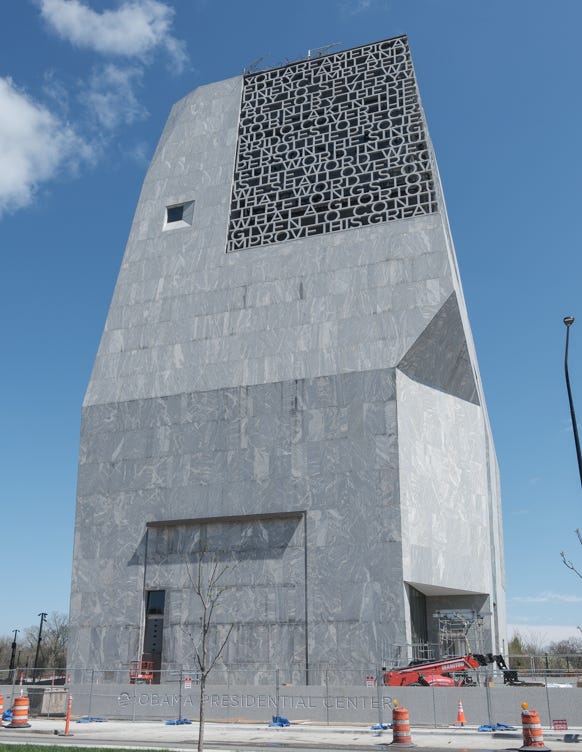

During a visit to Chicago last week, I spied something new to me on the Dan Ryan: exit signage for the Obama Presidential Center. Set to open to the public this Friday, on Juneteenth, the Obama Presidential Center is, by all accounts, visually stunning. The building is striking and the entire campus — with a basketball court, fruit and vegetable garden, and a new branch of the Chicago Public Library — has re-imagined what a presidential library can be. Kelsey Ables’ piece in The Atlantic is most useful not as a verdict on the Obama Presidential Center — she is admirably balanced — but as an opening for a question archivists and librarians are well-positioned to take up. There are two key ways that the Obama Presidential Center has re-imagined presidential libraries that have prompted some concern: the archives are in Maryland; and the institution overseeing the library is not the National Archives, but the Obama Foundation. What Ables gestures toward is why archives and records matter beyond any one presidency: what is lost, structurally and over time, when the stewardship of an administration’s historical record becomes a product of that administration.
Before I get into the substance of Ables’ piece, I must confess that I had a reaction early on reading Valerie Jarrett’s explanation why the physical archives are not at the Center: “The advantages of having everything in one location might be fun for people who like to sift through the papers.” Now, I admit I am exactly the sort of person who finds sifting through papers fun (at times), but I balk at the insinuation that paper-based research is a frivolity. Jarrett continued: “We would much rather have a Chicago Public Library on our site than filling it up with a bunch of papers.” Ouch. “A bunch of papers” comes across as a frank dismissal, and a revealing one. For anyone who works in libraries or archives, the phrase lands with a particular thud (imagine a dense 15x12x10 storage box being dropped on a table — it’s that sound). Archivists and records managers have spent the better part of a century making precisely the opposite argument: that documents are not inert objects but the evidentiary infrastructure of accountability. The archive serves as an authoritative record of what happened, who decided it, and on what basis. Or it should, anyway — especially in the case of a presidential library.
In fairness to Jarrett and the Obama Foundation, they counter that while the physical archives will not be permanently stored in Chicago, the records are in the process of being fully digitized, a first for presidential records. NARA will also loan items to the Center. If the records are fully accessible online through NARA’s Barack Obama Presidential Library website, the physical location of documents becomes less significant than it once was. The democratic promise of the archive — that any citizen can access the record — is arguably better served by digitization than by a research facility that, in practice, only scholars with the means to travel to it will ever use. Jarrett’s “bunch of papers” may be glib, but the underlying point isn’t entirely wrong: in a digitally-oriented age, equating the archive with its physical form is its own kind of category error.
However, digitization is not the same as independence. The question was never primarily about physical access to documents — it was about who controls the interpretive layer above those documents: the museum, the narrative, the storytelling council, the exhibit text. NARA digitizing Obama’s records is genuinely important. But the Obama Presidential Center is where most people will encounter the Obama presidency, and that institution is entirely outside NARA’s purview. The archives may be open; the story built on top of it is not subject to the same accountability.
And perhaps I am stating the obvious, but digitization is also not permanent or neutral. What gets digitized, in what order, with what metadata, and with what guarantee of long-term preservation are all meaningful decisions — and ones that benefit from professional and nonpartisan archivist oversight.
The framing also deserves scrutiny as rhetoric. Jarrett’s comment positioned the choice as one between community amenities — a public library branch, a basketball court, green space for a neighborhood that has long needed investment — and filling the campus with bureaucratic paperwork. This is a false binary. The argument against the Center’s independence from NARA has never been that archives should displace community programming. Community investment and archival accountability are not in competition with one another, and framing them as such obscures what is actually at stake.
Now, getting to the rest of Ables’ piece. She situates the Obama Presidential Center in the broader history of American presidential libraries. The presidential library system was built on a deceptively simple premise: the papers of a president belong not to the president, but to the people. Since Franklin D. Roosevelt first worked with historians and archivists to establish a federally affiliated home for his records, the National Archives and Records Administration has served as the institutional guarantor of that premise — providing nonpartisan oversight, professional curatorial standards, and a structural commitment to a holistic assessment of a president’s terms.
The value of that structure is easiest to see where it was tested most severely. As Ables recounts, the Nixon Presidential Library operated independently for years under the stewardship of Nixon allies before coming under NARA’s umbrella in the 2000s — and the difference was measurable. A Watergate exhibit that had presented a deeply partial account of events was revised into something far more candid once professional archivists and historians, operating under a nonpartisan mandate, were part of the institutional fabric. The lesson was not that federal oversight guarantees good history. It is that without a structural commitment to the public interest — one that exists independently of the preferences of those whose legacy is at stake — the incentives reliably run in one direction. Presidential libraries, left entirely to their own devices, tend toward commemoration. The Nixon Presidential Library example reminds us that these concerns are not relics of ancient history. The federal framework has existed, imperfectly but meaningfully, to pull against that tendency — and it is what the Obama Presidential Center has opted out of.
For those who think seriously about libraries as democratic institutions, the Obama Presidential Center’s independence from NARA raises concerns that go beyond archival logistics. What distinguishes a library from a legacy operation is not the ambition of its programming or the grandeur of its architectural design. It is a structural commitment to access over image management — to serving the full community, including those who would complicate or contest the prevailing narrative. The Center has assembled a storytelling council of historians and scholars, and by all accounts the museum engages critically with the administration’s shortfalls. These are not cosmetic gestures. But good intentions are not a structural safeguard. The relevant question is not whether Barack Obama is capable of intellectual honesty — he clearly is — but whether the institution built in his name will sustain that honesty across decades, leadership transitions, and funding pressures that we cannot fully anticipate. Depending on the goodwill of the very people whose records are in question is a significant ask of the public.
Here it is worth pausing to consider the case for the Obama Presidential Center’s model, because it is not a trivial one. Federal affiliation carries its own liabilities: NARA funding is subject to Congressional appropriations, and federal employees can be fired. The recent brief closure of the Kennedy Presidential Library, a casualty of federal staffing cuts, illustrated in concrete terms how precarious the federal safety net can be. The Obama Foundation has noted, pointedly, that its center will not have to pause operations during a government shutdown — a fair observation in the current political climate.
There is a broader argument here too. Many mission-driven nonprofits and cultural institutions have moved toward hybrid public-private models precisely because sustained public funding is neither reliable nor politically insulating, and foundation-run institutions have demonstrated, across many fields, a genuine capacity for long-term stewardship of important public missions. A well-endowed private foundation may be better positioned to protect institutional integrity over the long term than one dependent on the goodwill of whichever administration controls the federal budget. In an era when history itself has become contested terrain — when federal cultural institutions are subject to political interference and the Smithsonian is not immune — a former first family wanting to hold their own story close is understandable.
This argument deserves to be taken on its merits. And yet.
The public-private partnership model works best when two conditions are met: when the private partner’s interests are structurally aligned with the public mission over time, and when there are meaningful accountability mechanisms for when those interests diverge. How robustly the Obama Presidential Center will satisfy either condition over the long term remains to be seen. The founding generation’s commitment to candor is real, and there is every reason to hope it proves durable. But institutional cultures shift, funding landscapes change, and founding commitments have a way of becoming harder to sustain as the distance from the original moment grows. What the center’s current structure offers is a promising beginning — what it cannot yet offer is a guarantee of the kind that only institutional accountability, built into the architecture from the start, can provide.
This would be worth noting even if the Obama Presidential Center were an isolated case. It is not. At the George W. Bush Presidential Library, NARA retained control of the archival functions while the museum and all public programming transferred to the Bush Foundation in 2023 — severing, on a single campus, precisely the connection between records and interpretation that the presidential library system was designed to preserve. Donald Trump’s coming presidential center is privately controlled, and Trump has claimed his records belong to him rather than the public. Now, these are not equivalent situations, politically or morally. But they are part of the same institutional story: the gradual normalization of private control over the presidential record. Each departure from the federal model makes the next easier to justify, and the Obama Presidential Center’s independence — however well-motivated — is now part of that pattern whether it intended to be or not. Nevertheless, much of what I have presented in this piece is speculative. The Obama Presidential Center may prove to be a model worth emulating. Time will tell.
Libraries, at their best, have always insisted on a distinction that is easy to blur in the short term: the difference between serving a community’s desire for comforting narratives and serving its need to know. Presidential libraries were never the perfect embodiment of that distinction. But the federal framework has provided, at minimum, a structural argument for the public interest — one that exists independently of the preferences of those whose legacy is at stake. When that framework becomes optional, the structural argument goes with it. And the questions that remain — about access, accountability, and who ultimately owns the historical record — are ones that librarians and archivists have been thinking about for a long time.
Though perhaps my writing about the Obama Presidential Center without having visited in person is tantamount to being the individual who forms opinions about a book she hasn’t read. So, to the thousands of professionals attending ALA Annual this month, not to mention those already in the Chicago area, please share your impressions of the Center!
To promote viewpoint diversity, Heterodoxy in the Stacks invites constructive dissent and disagreement in the form of guest posts. While articles published on Heterodoxy in the Stacks are not peer- or editorially-reviewed, all posts must model the HxA Way. Content is attributed to the individual contributor(s).
To submit an article for Heterodoxy in the Stacks, send an email with the article title, author name, and article document to hxlibsstack@gmail.com. Unless otherwise requested, the commenting feature will be on. Thank you for joining the conversation!
Thank you, Caroline, for this thoughtful piece on emerging models for Presidential libraries that move toward privatization rather than as custodians of presidential records for the public good, and for transparency,, and of course for the scholarly record in political history. Excellent perspectives here that avoid politicization around particular Presidents and their agendas.
With deep regret, over the past 25 years I've had to shred many boxes of old (some over 70 years old) law office files, for the obvious reason: the "new" old files needed the storage space.
But with horror, I've watched our court systems, whose files I've roamed for over 40 years in search of things I needed to know about, have been turned over to the giant technocratic eraser of some of the most relevant records of human history from the 20th century.
If you have ever spent any time inside legal archives (and are paying attention) you know you are holding and reading records that display and articulate how our legal systems have really functioned, especially as it relates to the waywardness of our criminal justice systems, and ~ as always ~ the very class-based behaviors of our courts in relation to civil proceedings as well. And, of course, regardless of what state, you stumble over detailed proof of the horrendous treatment of women and fellow citizens with certain ethnic roots that don't gibe with the powers that be.
But thanks to the takeover by "digital minds" of our biology-matters human communities, all that history is being erased, for the machines have no use for how knowledge of the past helps us learn from our mistakes. It truly is horrific in the long term, when you think that given our nature we are not going to prepare ourselves, one another, or our neighborhoods for the oncoming collapse of so much of how we live due to ecological overshoot, so that when the time comes when it might behoove us to try to understand who we were, all the old scrolls that recorded what actually was happening will be long gone right about the time the lights go out.